
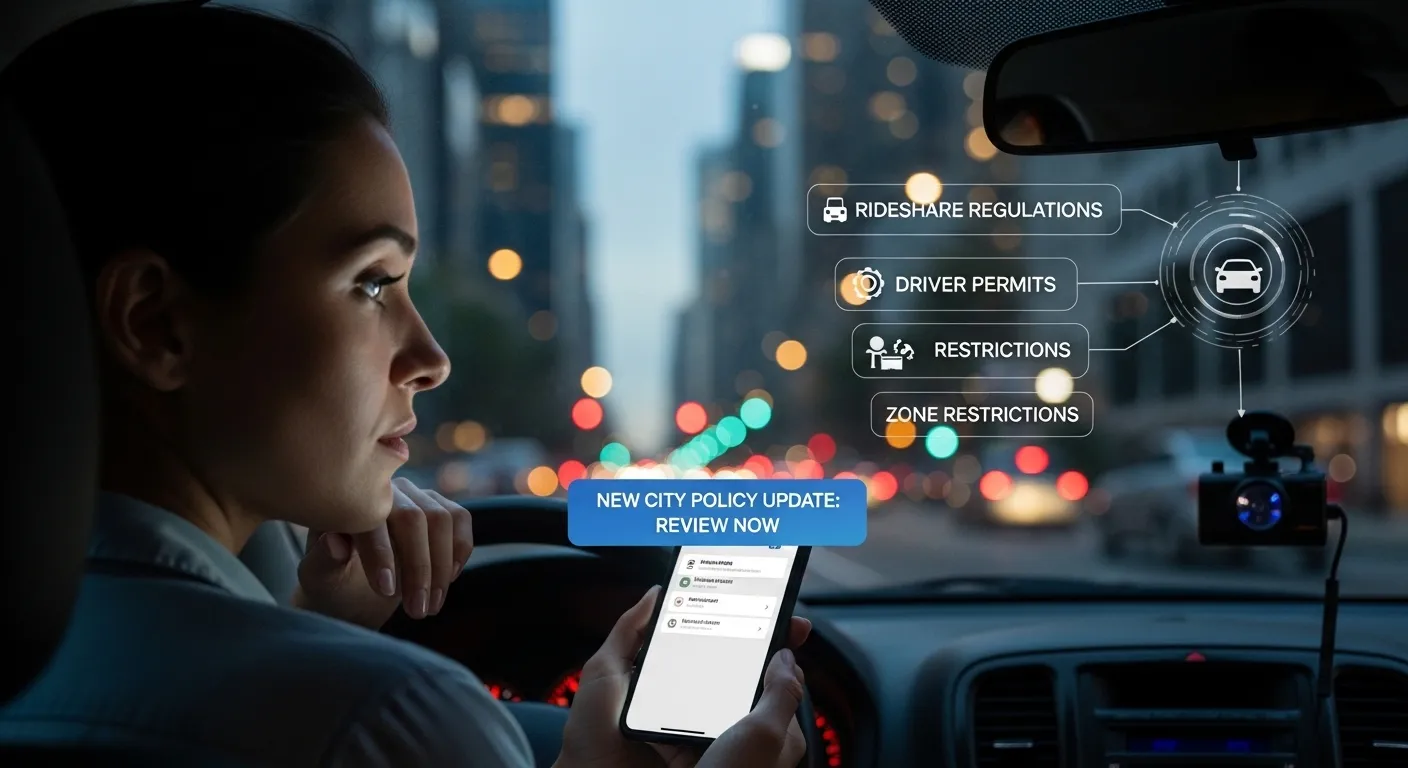
New rideshare regulations are no longer a side issue in 2026. They are becoming one of the main forces shaping what drivers earn, what riders pay, what protections exist during a trip, and how much control the platforms still have over the rules of the game. For years, rideshare companies moved faster than lawmakers. That gap is shrinking.
The result is a more complicated market, but also a more serious one. Drivers are seeing new rules around pay, bargaining rights, benefits, accessibility, and reporting. Riders are seeing the effects through pricing, service design, platform accountability, and a broader push for safer and more consistent access. This is not one law in one city. It is a pattern.
If you have followed our earlier posts on Lyft’s gas relief program in 2026, Uber vs Lyft for drivers in 2026, Lyft’s service animal settlement, and the best rideshare safety features in 2026, this is the bigger policy layer underneath all of them. The apps may still look simple on the surface, but the business behind them is becoming more regulated, more contested, and more political.
Pay and benefit rules are setting a higher bar

One of the clearest regulatory shifts is that states are no longer waiting for rideshare companies to define fair pay on their own. Massachusetts is one of the strongest examples. Under the settlement framework now in effect, Uber says Massachusetts rides drivers are guaranteed minimum active-time earnings of $34.48 per hour, can accrue up to 40 hours of paid sick leave annually, and have access to occupational accident coverage, paid family and medical leave support, health stipends, and deactivation review tools. New York’s attorney general settlement also remains a major benchmark because it established a statewide earnings floor outside New York City and guaranteed paid sick leave through the apps.
Why this matters for drivers
For drivers, this is a direct challenge to the old model where gross pay could look acceptable while real take-home pay stayed unstable and hard to predict. Earnings floors and benefit structures do not solve every driver complaint, but they do create a stronger baseline. That matters most for drivers in markets where trip quality fluctuates, dead miles are high, or platform incentives are inconsistent.
Why riders should care too
Riders often hear about driver protections and assume it is someone else’s issue. It is not. Better pay floors and basic benefit rules can influence who stays on the platform, how many drivers remain active, and whether the service feels stable during peak periods. They can also affect fares. That is the trade-off regulators and platforms keep circling around.
The real shift
The real shift is that rideshare pay is becoming harder for platforms to define entirely on their own. State action is forcing more structure into a business that long relied on flexibility and opaque pricing logic.
California is changing the labor model without abandoning contractor status
California’s new Transportation Network Company Drivers Labor Relations Act is one of the most important rideshare policy developments in the country. AB 1340, approved on October 3, 2025, gives TNC drivers the right to organize, participate in driver organizations, and bargain through representatives of their choosing. The law sets a process for quarterly data submission, organization certification windows starting on or after January 1, 2026, and support thresholds that can begin the certification process after May 1, 2026.
Why this is a bigger deal than it first sounds
This law matters because it creates a formal bargaining framework without fully converting drivers into employees. That is a major policy compromise. It reflects a new regulatory direction: governments may no longer accept the old binary choice of either full employee status or near-total platform control. California is trying to build something in between.
What that could mean for drivers
If the framework works, drivers may gain more leverage over compensation and working conditions without losing the flexibility that platform companies and many drivers still want to preserve. That is an inference from the law’s design rather than a guaranteed outcome. The actual effect will depend on whether driver organizations gain enough support, how negotiations unfold, and whether sectoral agreements produce meaningful gains.
What that could mean for riders
For riders, the most likely effects would be indirect: more formal labor negotiations, potential changes to pricing or service economics, and a system where platform rules are less one-sided than before. Even where riders do not notice the law directly, they may notice what it changes underneath the app.
Accessibility enforcement is getting much sharper
Another major regulatory direction is disability access. In September 2025, the U.S. Department of Justice sued Uber, alleging repeated discrimination against passengers with disabilities, including riders with service animals and riders using stowable wheelchairs. Then in March 2026, Minnesota announced a settlement with Lyft after investigating repeated denials involving a blind rider and her service dog. The settlement requires driver education, app updates, follow-up on every refusal report, and stronger accountability for drivers who break the rules.
Why this matters beyond one company
The Lyft settlement is formally specific to Lyft, and the DOJ lawsuit is formally against Uber. But the wider message is obvious: accessibility is no longer something platforms can treat as a policy page buried in a help center. Enforcement agencies are now treating rideshare access as a real civil-rights issue with operational consequences.
What drivers should take from this
Drivers should treat service-animal and disability-accommodation rules as core job requirements, not optional customer-service issues. The trend is toward more training, more complaint follow-up, and less tolerance for refusals that violate disability law. That raises the risk for drivers who ignore the rules and raises the standard for the platforms that rely on them.
What riders gain
Riders with disabilities may not suddenly get a perfect system, but the direction is clearly toward stronger reporting tools, clearer app prompts, and more visible consequences when access is denied. That is a meaningful shift from vague policy promises to monitored compliance.
Insurance regulation can change fares and risk at the same time

Insurance rules do not get as much public attention as pay fights, but they shape the economics of rideshare in a big way. California’s SB 371, approved on October 3, 2025, lowered the state’s required uninsured and underinsured motorist coverage during the in-vehicle phase from $1 million to $60,000 per person and $300,000 per incident, while preserving $1 million in primary liability coverage. The law also requires the transportation network company itself to provide the UM/UIM coverage and orders state reporting on accidents, claims, and average rider fares across 2025 and 2026 periods.
Why this matters for riders and drivers
Insurance mandates are one of the hidden cost layers inside every trip. Lower required coverage in one area can reduce cost pressure on the system, which could support lower fares or better driver economics. That is a reasonable inference, and it is clearly part of the policy logic behind the California compromise. But it also means there is an active debate about whether lower required coverage in that category shifts too much risk when serious accidents happen.
What riders should watch
Riders should pay attention to whether insurance reform is actually followed by more affordable rides or better service availability. California built a reporting mechanism into the law for a reason. Lawmakers clearly expect the market impact to be measured, not just promised.
What drivers should watch
Drivers should watch whether insurance reforms translate into better net earnings, stronger platform demand, or simply new corporate talking points. Regulatory change only matters when it changes real outcomes on the road.
Transparency regulation may be the next big fight
Pay transparency and algorithmic accountability are still one of the least-settled parts of rideshare regulation, but the pressure is building. In December 2025, members of Congress introduced the Empowering App-Based Workers Act. It is not law, but it points clearly to where the next policy argument is going. The proposal would require detailed weekly pay statements, disclosure of electronic monitoring and automated decision systems, a 75 percent driver share of the total amount paid by the consumer, and protections against unequal pay for similar work.
Why that proposal matters even before passage
Even as a proposal, it signals that lawmakers are increasingly interested in the black box at the center of app-based work: how the algorithm sets pay, routes work, monitors behavior, and shapes driver outcomes. That issue has been sitting under the surface for years. It is now moving closer to the center of the regulatory conversation.
Why drivers care
Drivers do not just want higher pay. Many want clearer pay. They want to understand how the platform is making decisions that affect earnings, visibility, deactivations, and trip quality. That is why transparency rules may become just as important as wage rules in the next stage of regulation.
Why riders may care too
Riders may eventually care because opaque algorithms affect pricing, wait times, and matching too. Once governments start pulling harder on transparency, the result may not only be better information for drivers but a less mysterious experience for riders as well.
Final thoughts
New rideshare regulations in 2026 are not moving in just one direction. They are pushing on several pressure points at once: pay, benefits, bargaining power, insurance, accessibility, and transparency. That makes the regulatory picture messier, but also more honest. The industry is maturing, and governments are treating it less like an experiment and more like a real transportation system with real labor and civil-rights consequences.
For drivers, that could mean a stronger floor, better bargaining power, more reporting rights, and more compliance expectations. For riders, it could mean better access protections, more accountable platforms, and changes in price or service quality depending on how markets absorb the new rules. Either way, the message is clear: rideshare is no longer just an app story. It is a regulation story too.
For the official California bill text behind one of the biggest 2026 shifts, see California AB 1340.